How to Prepare Your Lot for New Construction in Portland
Building a new home in Portland? Here's every step of lot preparation — from clearing and grading to utilities and permits — and what each phase costs.
You bought a lot. Now what?
Between owning a piece of land and watching a house go up on it, there's a phase most people don't think about until they're in it: lot preparation. This is the excavation and site work that transforms raw land into a buildable surface — clearing vegetation, grading the terrain, connecting utilities, and preparing the foundation site. In Portland, where lots range from flat urban infill parcels to steep, wooded hillsides in the West Hills, the scope and cost of this work varies dramatically.
Here's what's involved, what it costs, and what most first-time builders don't know until it's too late.
Step 1: Survey and Soil Testing
Before any dirt moves, you need two things.
A boundary survey confirms exactly where your property lines are and where the house can sit within setback requirements. If you don't already have one from the purchase, expect to pay $500 to $1,500 for a surveyor in the Portland metro area.
A geotechnical (soil) report tells you what's underground — soil type, bearing capacity, groundwater level, and whether the soil can support a standard foundation or needs special engineering. This matters a lot in Portland. Parts of SW Portland and the West Hills sit on landslide-prone slopes. Areas in East Portland and Gresham have heavy clay with poor drainage. Sandy soils near the Columbia River behave differently than the rocky ground in West Linn or Lake Oswego. A geotech report costs $1,500 to $3,000 and is required for most building permits in Portland.
Don't skip the geotech. If you find out after pouring the foundation that the soil can't support it, the fix costs ten times what the report would have.
Step 2: Permits and Tree Removal Authorization
Portland's permitting process for new construction is detailed. Your architect or builder typically handles the building permit, but the site work has its own permit requirements.
Tree removal permits. Portland's Title 11 tree code requires permits for removing trees over 12 inches in diameter on most residential lots. Some trees are protected — heritage trees, trees in environmental overlay zones, street trees. Removing a protected tree without a permit carries fines up to $1,000 per inch of diameter. Before clearing anything, have an arborist walk the lot and identify which trees can be removed, which need permits, and which must stay. The permit application includes a mitigation plan — you'll likely need to plant replacement trees.
Grading permits. If the site work involves moving more than 50 cubic yards of soil, a grading permit is typically required. Your excavation contractor should know the threshold for your jurisdiction.
Erosion control permits. Portland requires erosion control measures during construction to prevent sediment from entering the stormwater system. This includes silt fencing, straw wattles, sediment traps, and stabilized construction entrances. The specifics depend on the lot size, slope, and proximity to waterways.
Step 3: Land Clearing
Land clearing is the first physical work on the lot. This means removing trees (permitted ones), brush, stumps, and any existing structures or debris. In Portland, this commonly includes clearing blackberry bushes (which take over vacant lots within a couple of years), English ivy, Scotch broom, and other invasive vegetation.
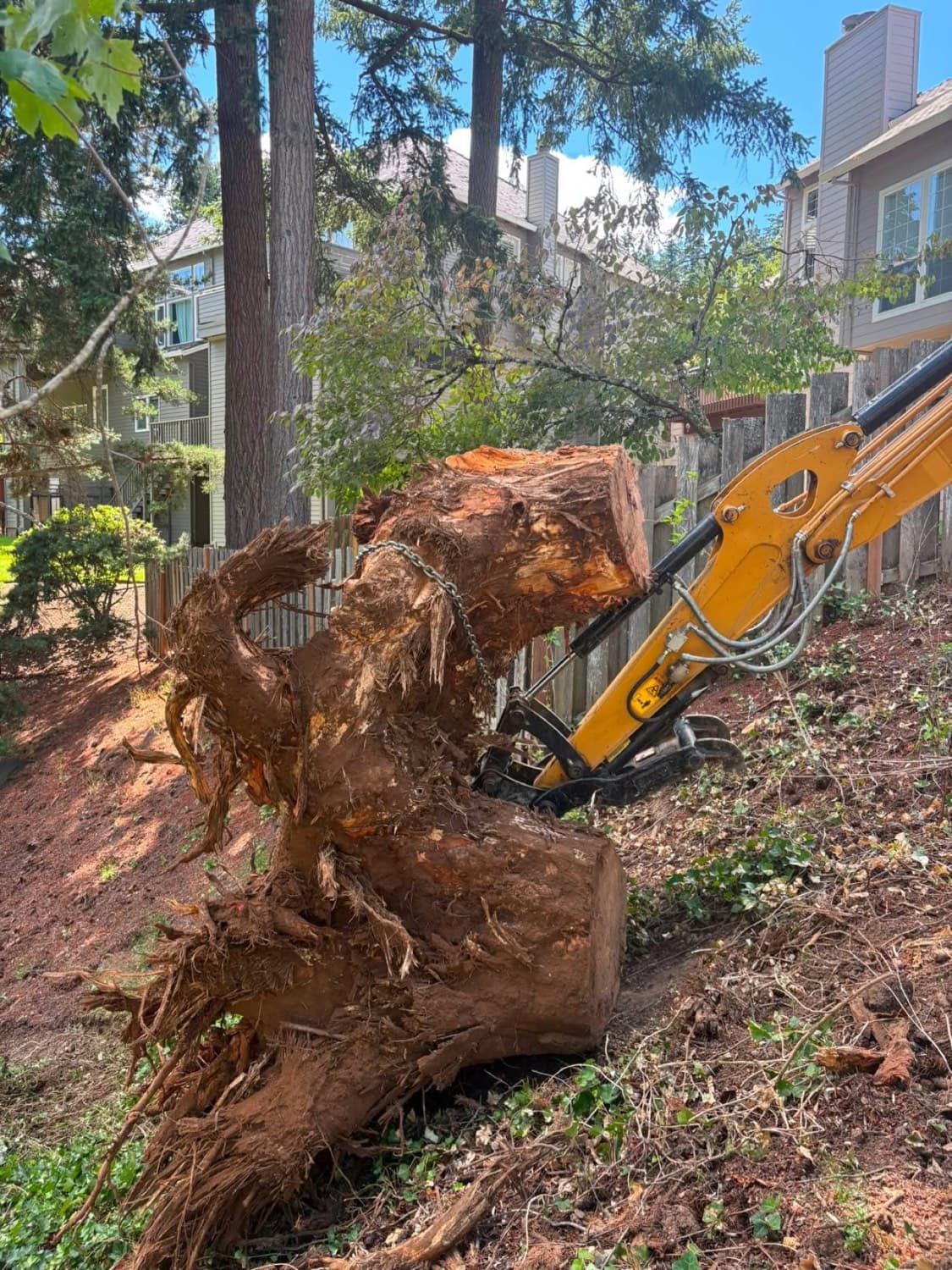
What's involved: The crew cuts and removes trees, grinds or excavates stumps, clears brush and vegetation, removes any existing structures (old sheds, fences, foundations), and hauls everything away. Usable timber may be salvaged. Brush and vegetation go to a green waste facility.
Portland-specific note: If the lot is in an environmental overlay zone (common near streams, wetlands, and steep slopes), there are additional restrictions on what can be cleared and how close to the resource you can work. Check your zoning before starting.
Cost: Lot clearing for a standard residential lot (5,000-10,000 square feet) with moderate vegetation and a few trees runs $3,000 to $10,000 in Portland. Heavily wooded lots or lots with large, mature trees cost more. The tree removal permits add $200 to $500 per tree.
Step 4: Rough Grading
With the lot cleared, the next step is rough grading — reshaping the land to establish the overall contours, drainage patterns, and elevation for the building pad.
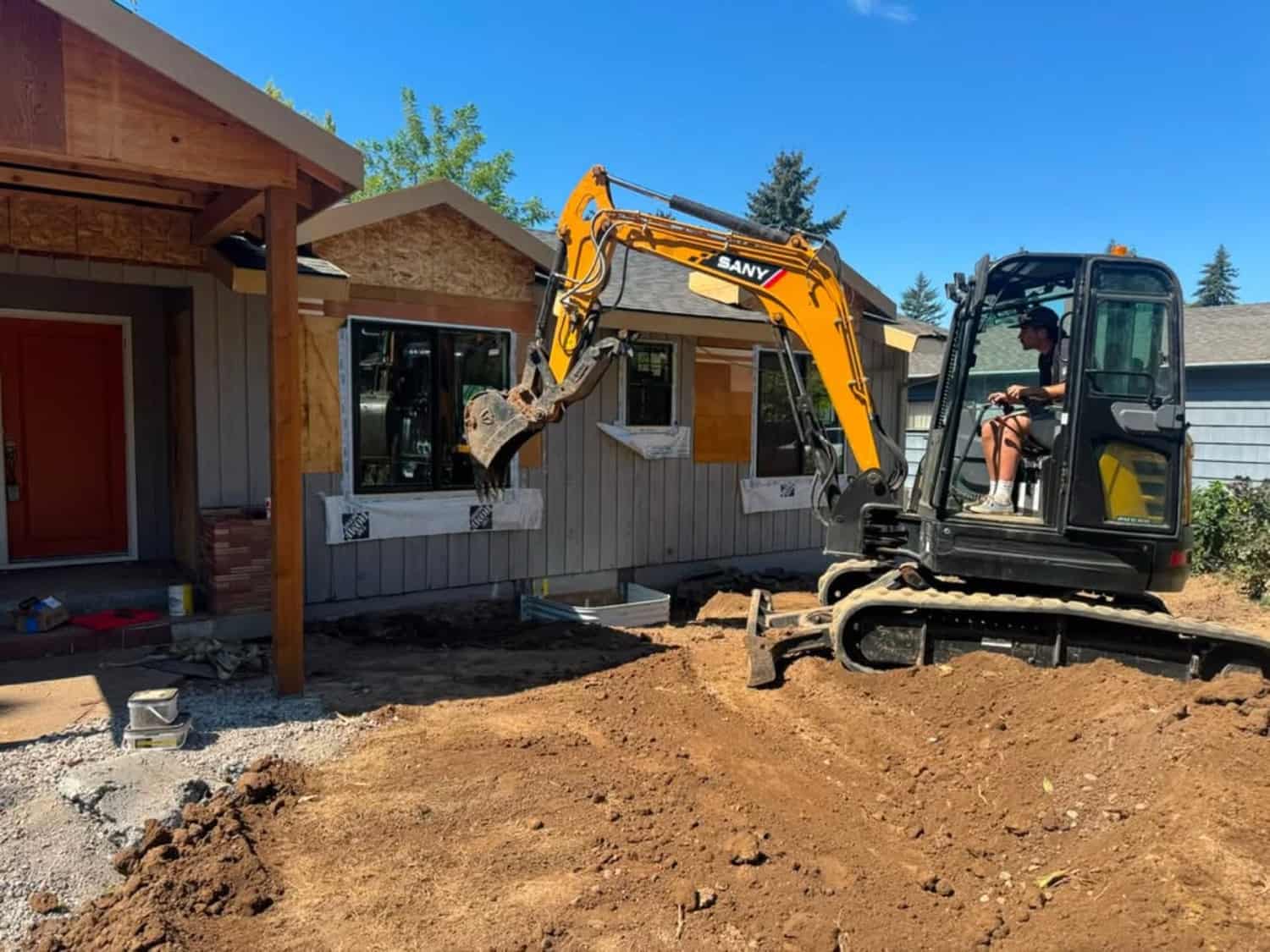
What's involved: An excavator or dozer moves soil to create a relatively level area where the house will sit (the building pad), establish drainage slopes that direct water away from the future foundation, and create access for construction vehicles. If the lot is sloped, this may involve significant cut-and-fill work — cutting soil from the high side and filling the low side to create a level building area.
Portland-specific note: Portland's hilly terrain means many lots require substantial grading. Lots in the West Hills, Sylvan, or Council Crest may need retaining walls to manage the grade change. Lots in flat areas like Beaverton, Hillsboro, or the Columbia Corridor may need minimal grading but could have drainage challenges due to high water tables.
Cost: Rough grading for a standard residential lot runs $3,000 to $15,000 depending on the lot size, terrain, and how much soil needs to move. Steep or complex lots can exceed $20,000.
Step 5: Utility Trenching and Connections
Your new home needs connections to water, sewer (or septic), electrical, gas, and communications. These are brought to the building site through underground utility trenches.
What's involved: The crew digs trenches from the utility connection points (typically at the street) to the house location. Each utility has specific depth and separation requirements. Water lines need to be below the frost line (30-36 inches in Portland). Sewer lines need to maintain gravity slope (1/4 inch per foot minimum). Electrical conduit is typically 18-24 inches deep. Gas lines vary by pressure. The actual pipe and wire installation is done by licensed plumbers and electricians — the excavation crew digs the trenches, installs bedding, and backfills after the trades are done.
Portland-specific note: If you're connecting to Portland's combined sewer system, you'll also need a stormwater management plan. New construction typically requires on-site stormwater management — which may mean installing a dry well, soakage trench, or other infiltration system rather than connecting roof drains directly to the sewer.
Cost: Utility trenching runs $5 to $30 per linear foot depending on depth and soil. For a typical lot where the house sits 50-100 feet from the street, trenching for all utilities combined runs $3,000 to $8,000 for the excavation work alone. Utility connection fees from the city are separate and can add $5,000 to $15,000 depending on what's available at the street.
Step 6: Foundation Excavation
With the site graded and utilities roughed in, the crew excavates the foundation. This is the precise dig that creates the hole where your home's foundation will be poured.
What's involved: Foundation excavation means digging to the exact depth, width, and dimensions specified in the structural plans. The crew uses laser levels and grade stakes to maintain accuracy. After excavation, the base is prepared with compacted gravel, and the site is left clean and ready for the foundation contractor to set forms and pour.
Portland-specific note: Foundation type depends on soil conditions (from the geotech report). Most Portland homes use either a slab-on-grade, a crawlspace, or a full basement. The geotech report will specify whether standard footings work or whether the soil requires deeper footings, helical piers, or other engineering.
Cost: Foundation excavation for a standard single-story residential foundation runs $5,000 to $15,000 in Portland. Basements, difficult soil, and large footprints push higher.
Step 7: Erosion Control and Site Stabilization
Once the major earthwork is done, erosion controls go in (or get reinforced — some should be in place from the start of clearing). This includes silt fencing around the perimeter, straw wattles on slopes, a stabilized gravel construction entrance to prevent trucks from tracking mud onto the street, and seeding or covering any exposed soil that won't be disturbed for a while.
Portland takes erosion control seriously. Inspectors check sites, and violations carry fines. Your excavation contractor should install and maintain erosion controls as part of the site work.
Total Cost: What to Budget for Lot Preparation in Portland
For a standard residential lot in the Portland metro area, here's a rough budget framework for the full site preparation scope.
Survey and geotech: $2,000 to $4,500. This is non-negotiable groundwork.
Permits (tree removal, grading): $500 to $2,000. Varies by jurisdiction and number of trees.
Land clearing: $3,000 to $10,000. Depends on vegetation density and tree count.
Rough grading: $3,000 to $15,000. Depends on terrain — flat urban lots are cheaper, hilly lots cost more.
Utility trenching: $3,000 to $8,000. Excavation only — utility connection fees are separate.
Foundation excavation: $5,000 to $15,000. Depends on foundation type and soil.
Erosion control: $500 to $2,000. Materials and installation.
The total range for site preparation in Portland runs roughly $17,000 to $55,000, with the wide range reflecting the difference between a flat, cleared urban infill lot (lower end) and a steep, wooded hillside lot (higher end). A typical suburban lot with moderate clearing and normal soil lands somewhere in the $20,000 to $35,000 range.
Common Mistakes First-Time Builders Make
Not doing the geotech early enough. The soil report affects everything — foundation design, drainage, lot layout. Getting it after plans are drawn can force expensive redesigns.
Underestimating tree removal costs and timelines. Portland's tree code is strict. The permit process takes time, and mitigation requirements add cost. Start the tree survey early.
Ignoring drainage during grading. It's tempting to focus on making the building pad level and deal with drainage later. Don't. Drainage slopes need to be established during rough grading — retrofitting them after the house is built costs much more.
Not coordinating trades. Utility trenching needs to happen in the right sequence — typically water and sewer first, then electrical and gas, then communications. Trenches for different utilities often share the same corridor. Good coordination means fewer trenches, less disruption, and lower cost.
Get Started
If you're building in the Portland metro area and need site preparation, call (503) 983-6984 or request a free estimate. We handle the full scope — clearing, grading, trenching, and foundation excavation — so you have one crew and one point of contact for everything that happens before the builder starts framing.